App to Keep Receipts for Taxes: Because Receipts Always Go Missing at the Worst Time
Receipts are annoying.
Not when you get them. At that point they feel harmless. A small paper receipt from the gas station. An email from a software company. A Home Depot receipt folded into your wallet. A parking receipt you tossed into the center console because you were in a hurry.
No big deal.
Then tax season shows up, and suddenly every little receipt matters.
That $67 from Staples. The gas from February. The online course you paid for. The replacement charger. The tools. The parking. The client coffee you were sure you’d remember. The subscription that keeps showing up on your bank statement but doesn’t explain what it was actually for.
This is why people start looking for an app to keep receipts for taxes.
Not because they want more admin.
Because they want less panic later.
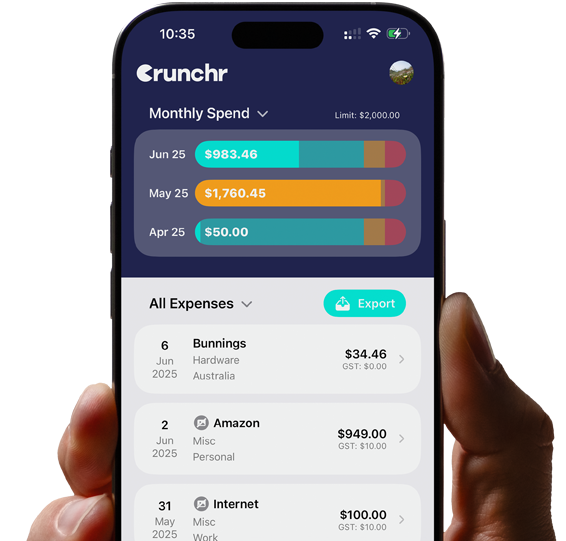
Crunchr was built for that simple problem: keep the receipt before it disappears.
You take a photo, store the record, add a note if needed, and get on with your day. Nothing fancy. Nothing that requires you to become an accountant. Just a cleaner way to stop everyday expenses turning into a mess at the end of the year.
The small receipts are usually the problem
People usually remember the big things.
A laptop. A phone. A major tool. A big course. A large invoice from a supplier. Those purchases stand out because they cost enough to hurt a little.
It’s the small expenses that vanish.
Gas. Parking. Office supplies. Printer ink. Work clothes. A notebook. Postage. A toll. A cable. A monthly subscription. A quick stop at Lowe’s on the way to a job.
Each one seems too small to worry about.
But small expenses are sneaky. They pile up quietly. Then months later you’re trying to work out whether something was personal, business-related, client-related, or half and half.
A bank statement might show where you spent the money. It rarely tells the whole story.
That’s where the receipt helps.
The receipt says what happened. The note says why.
And if you capture both while the purchase is fresh, future-you has a much easier time.
Paper receipts are a terrible long-term plan. Everyone knows this, but we still keep them anyway. They fade. They rip. They get lost. They sit in a hot car until the print almost disappears. They go through the wash. They end up in the one drawer in the house where useful things go to die.
You can keep them in a folder if you’re organized.
Most people are not that organized. Or they are organized for three weeks, then real life wins again.
That is why a receipt app makes sense. It gives every receipt somewhere to go straight away.
Not five places.
One place.
Tax records should not live everywhere
This is what usually happens.
Some receipts are in your email. Some are in your camera roll. Some are printed. Some are screenshots. Some are in an app. Some are attached to a supplier account. Some are in the car. Some are in a pile on the kitchen counter. Some are definitely “somewhere.”
That word is dangerous.
Somewhere usually means lost.
Crunchr gives you a simple habit. When a receipt comes in, save it. If it needs context, add the context. If it belongs to work, business, a rental property or a client, make that clear while you still remember.
You do not need to make it complicated.
Actually, complicated is usually why people stop doing it.
The best system is the one you will still use when you are tired, busy, distracted, running late, sitting in the car, or just trying to get through the day.
A bank transaction is not the same as a receipt
A bank transaction can be useful. It tells you money moved.
But money moving is not always enough.
Staples could mean printer paper for your business, school supplies, a charger, a printer cartridge, or something personal. Home Depot could mean supplies for a job, repairs for a rental property, or garden stuff for home. Amazon could be almost anything. A coffee shop could be lunch, or it could be a client meeting.
The transaction gives you a clue.
The receipt gives you detail.
This matters when you are preparing records for taxes, reimbursement, your CPA, or just trying to understand where the money went.
It is very easy to look at a transaction months later and think, “I know that was for something.”
That is not a record.
That is a guess.
Crunchr helps you avoid the guessing.
Who actually needs this?
More people than you’d think.
Small business owners need it because they already have enough to manage. Receipts should not become another end-of-quarter or end-of-year drama.
Freelancers need it because expenses are rarely neat. One month it’s software and a course. Next month it’s equipment, travel, hosting, parking and a client meeting. Some costs repeat. Some happen once and are forgotten almost immediately.
1099 contractors need it because they are often buying things while moving between jobs. A receipt in the truck is not a system. It is a delay.
Employees need it when they have work-related expenses or need to submit receipts for reimbursement. Equipment, travel, training, mileage-related costs, home office items, professional memberships. These costs can easily mix into normal personal spending unless you separate the record early.
Rental property owners need it because property expenses come from everywhere. Repairs, maintenance, cleaning, landscaping, insurance, HOA fees, property management fees, hardware stores. If you own more than one property, it gets messy even faster.
Different people. Same issue.
The receipt was there.
Then it wasn’t.
Camera roll photos help, but only a bit
Taking a photo of a receipt is better than doing nothing.
But after a while, your camera roll becomes its own version of the shoebox. Receipts mixed with screenshots, family photos, videos, random documents, parking signs, meals, pets, and things you photographed because you thought you’d need them later.
You might have the receipt.
Finding it is another story.
Crunchr gives the receipt a proper home. That matters because storing a receipt is only useful if you can actually find it later.
A photo buried in 6,000 other photos is not ideal.
Better than nothing, yes.
Still annoying, also yes.
The shoebox method is punishment with a lid
The shoebox method has survived for years because it feels easy at the start.
You throw receipts into a box. Done.
Except you haven’t done anything. You have just postponed the work.
Eventually someone has to open the box and sort the pile. Work out categories. Match receipts to bank transactions. Read faded amounts. Guess what something was for. Put things in order. Explain the weird ones.
Sometimes that person is your CPA.
Usually, it ends up being you.
Crunchr is basically the opposite approach.
Deal with the receipt while it still makes sense.
A few seconds now is better than a weekend later.
Why spreadsheets fall apart
Spreadsheets can be great.
But they are not great at catching receipts in real life.
A spreadsheet waits for you. It sits there politely until you have time to open it, enter the details, upload or link the receipt, choose a category and keep everything updated.
That sounds fine if life is calm.
Life is usually not calm.
You buy things between jobs, after meetings, on the way home, during school pickup, at the airport, in a rush, half distracted, or while thinking about five other things.
By the time you sit down to update the spreadsheet, the receipt may already be missing.
Crunchr works better as the first step.
Capture the receipt first. Review, export or organize later.
That order fits real life better.
Do not wait until tax season
Waiting until tax season to organize tax receipts is like waiting until moving day to start packing.
Technically possible.
Not enjoyable.
The problem is that time removes context. You forget why you bought something. You forget which job it related to. You forget whether it was fully business-related or partly personal. You forget where the receipt went. You forget the small details that were obvious on the day.
That is the whole point of saving the record early.
Crunchr helps you build the trail during the year. Not perfectly. Not obsessively. Just enough that you are not starting from zero when tax season arrives.
That alone can change how tax season feels.
It also helps your CPA
Your CPA or tax preparer does not want a mystery novel.
They want clear records.
What was bought? When? From where? For what purpose? Is there a receipt? Is there a note if the reason is not obvious?
Crunchr does not replace tax advice. It does not decide what you can deduct. That is not the job.
Its job is simpler: help you keep the receipt and the details together so the tax conversation is easier.
Less guessing.
Less digging.
Less “I’m sure I had that somewhere.”
Real examples, because this is where it matters
You buy gas for business travel. Save it.
You stop at Home Depot for materials. Save it before the receipt fades in the car.
You pay for parking at a client meeting. Add a note so you know what it related to.
You buy office supplies from Staples. Save the receipt and move on.
You order software online. Keep the invoice.
You pay for a training course. Keep the record.
You buy something for a rental property. Make sure you can tell which property it belongs to.
You buy something that is partly personal and partly business. Add a note while your brain still knows the answer.
None of this is exciting.
That is fine.
It is not meant to be exciting. It is meant to be useful.
The best time to save a receipt
The best time is when you get it.
Not later tonight.
Not Sunday afternoon.
Not when your CPA asks.
Not when tax season starts breathing down your neck.
When you get it.
That is when the details are fresh. That is when the receipt still exists. That is when it takes the least effort.
The longer you wait, the more work you create.
This is the small habit Crunchr is built around.
Receive it. Save it. Done.
Start smaller than you think
Do not start by trying to fix the whole year.
That is how people get overwhelmed and quit.
Start with the next receipt.
Just one.
Then the next.
That is how a record-keeping system actually becomes usable. Not through a giant clean-up. Through small repeated actions that are easy enough to keep doing.
A simple habit used often beats a perfect system used twice.
Every time.
The bottom line
If you need an app to keep receipts for taxes, Crunchr gives you a simple way to save receipts, organize expenses and avoid the usual tax-season scramble.
It helps with the real problem: receipts disappearing before you need them.
For freelancers, 1099 contractors, employees, small business owners and rental property owners, that can make a big difference.
Not because receipts are interesting.
They are not.
But losing them is a pain.
And Crunchr helps stop that.