Know Where Your Money Is Going
Expense Tracker App. Most people don’t have a spending problem so much as a visibility problem.
You buy things throughout the day and barely think about them. Fuel. Lunch. A subscription. Something for work. A few things online. Another small purchase that seems too insignificant to remember.
Then the month finishes and the total feels strangely disconnected from what you thought you spent.
That’s where an expense tracker app can be useful.
Not because every purchase needs to be judged, and not because tracking money should become another obsession. It simply gives you a clearer picture of what is happening.
The problem with money is that individual transactions are easy to understand. Patterns are harder.
You remember buying a coffee.
You probably don’t remember how much you spent on coffee over six months.
You remember paying for software.
You may not notice that five different subscriptions are quietly leaving your account every month.
Once those transactions sit together, the picture changes.
Expense tracking used to mean entering everything yourself
For years, keeping track of expenses meant a notebook or spreadsheet.
There’s nothing wrong with either of those.
They work.
The difficulty is that they rely on you.
You make a purchase, keep the receipt, remember what it was for, sit down later and enter everything correctly.
That sounds simple until life gets involved.
A receipt stays in the car.
Another one is in an email you meant to save.
A business purchase goes onto a personal card because it was easier at the time.
By Friday you have eight transactions to sort out and no desire to do any of it.
The spreadsheet wasn’t really the problem.
The delay was.
A good expense tracker app changes when the record gets created. Instead of trying to reconstruct everything later, you can capture the expense close to the moment it happened.
That tends to be much easier.
The receipt already knows most of what you need
One of the strange things about expense management is how often we manually type information that already exists.
The shop name is on the receipt.
So is the date.
The total.
Usually the items.
Sometimes tax information as well.
Yet traditionally someone has had to read all of that and enter it somewhere else.
Crunchr approaches the problem differently.
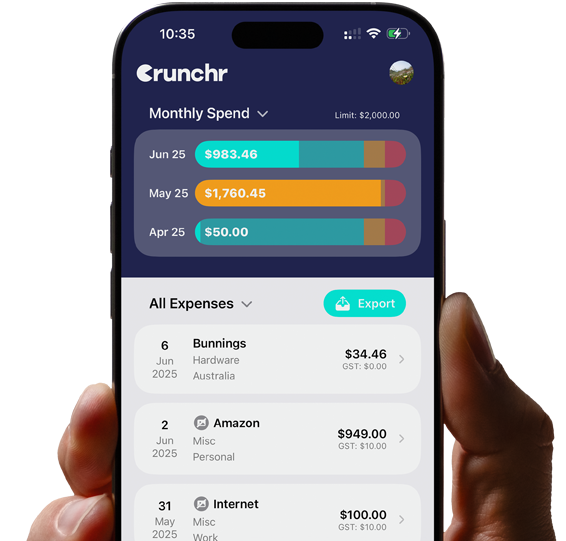
You can photograph a paper receipt or upload a digital one and use the receipt itself to create the record.
That matters because it removes one of the most tedious parts of expense tracking: entering every detail by hand.
The receipt also stays connected with the transaction instead of becoming a separate thing you need to file somewhere.
That sounds like a small improvement until you need to find a receipt from nine months ago.
Then it becomes a very useful one.
Personal spending looks different once you can see it
People are surprisingly good at remembering large purchases.
Small recurring ones are another matter.
It’s easy to think, “I don’t really spend much on that.”
And individually, you probably don’t.
But spending is repetitive.
$10 becomes $40.
$40 becomes $160.
Then the year finishes and the number is nothing like the one you had in your head.
An expense tracker app can make that visible without requiring you to sit down and analyse your bank statement every weekend.
You can group expenses into categories that actually mean something to you and look at the totals when you want to understand what’s happening.
Maybe eating out is higher than you thought.
Maybe it isn’t.
Maybe software subscriptions are becoming expensive.
Maybe fuel is the real problem.
Maybe nothing needs changing at all.
That last point matters.
Tracking isn’t automatically about cutting back.
Sometimes the value is simply knowing.
Small business expenses get messy very quickly
Business makes the problem more complicated because purchases have context.
A $250 transaction by itself doesn’t tell you much.
Was it equipment?
Materials?
Travel?
A purchase for a particular customer?
Something reimbursable?
Something personal that accidentally went through the wrong card?
Businesses deal with this constantly, particularly small businesses where the person spending the money may also be the person doing the accounts later.
That means the administrative work gets pushed to the end of the day.
Or the end of the week.
Or the end of the month.
This is where an expense tracker app can become less about budgeting and more about reducing admin.
Capture the purchase while it still makes sense.
Put it into the right category.
Keep the receipt with it.
Move on.
You’re not asking your future self to remember what happened.
Categories should match the way you actually work
One thing financial software often gets wrong is assuming everyone organises money in the same way.
They don’t.
A builder may care about individual jobs, materials, tools and fuel.
A photographer might think in terms of equipment, travel, locations and clients.
A consultant may want software, professional development and client expenses separated.
A property investor could want every property kept completely apart.
That’s why flexible categories matter.
Crunchr allows expenses to be organised in ways that reflect how the user actually thinks about them.
That’s more useful than forcing every transaction into a generic system that makes sense to the software but not necessarily to the person using it.
Business and personal spending don’t always stay separate
They should.
In real life, they don’t always.
A sole trader buys something for work using a personal card.
A mixed shopping trip contains both personal and business purchases.
Someone pays for a business expense themselves and needs to be reimbursed.
These situations are ordinary.
The difficulty appears months later when nobody remembers which transaction belonged where.
Using an expense tracker app throughout the year can make that separation happen earlier.
The difference is important.
Separating expenses when you make them is easy.
Separating them eight months later can be guesswork.
Receipts are useful long after the purchase
There’s another reason to keep expense records organised.
Sometimes you need the receipt for something completely unrelated to budgeting.
A warranty claim.
A return.
Insurance.
A reimbursement.
A question from your accountant.
A dispute about what was purchased.
Paper receipts are not particularly good long-term records. They fade, tear and disappear.
Even taking a photograph doesn’t completely solve the problem if you then have thousands of unrelated images on your phone.
The useful part is being able to find the record again.
Crunchr allows users to search stored receipt information and images, which means you don’t need to remember where you filed something.
You search for the purchase instead.
It’s a subtle change, but it makes digital record keeping much more practical.
Expense tracking is more useful when it connects with everything else
No single app needs to do every financial job.
Accounting software has its place.
So do bank feeds, budgeting tools and tax systems.
An expense tracker app can sit earlier in that process.
It captures what happened.
Keeps the evidence.
Organises the information.
Then the data can move somewhere else when required.
Crunchr supports exporting information into formats and workflows used with accounting platforms such as Xero, MYOB and QuickBooks.
That means you don’t have to rebuild the same information every time it moves to another system.
Capture it once.
Use it again.
Employees create another layer of complexity
Once several people are making purchases, expense management can become surprisingly fragmented.
One person has the receipt.
Another person approves the expense.
Someone else processes it.
Then somebody eventually needs the transaction for accounting.
Every handover creates an opportunity for something to disappear.
A receipt doesn’t get submitted.
The reason for the purchase is forgotten.
Someone waits three weeks for reimbursement.
Simple digital capture helps because the information can be recorded before the paper trail gets lost.
That doesn’t require a huge corporate expense system.
Sometimes it just requires a process people will actually use.
You probably don’t need more financial software
Most people already have enough apps.
The value of another one depends entirely on whether it removes work.
If using an expense app means entering more information, maintaining another dashboard and learning another complicated system, it has probably failed.
The whole point should be the opposite.
You spend money.
You capture the receipt.
The information is organised.
You can see your spending when you need to.
And then you get on with your day.
That’s why simplicity matters more than the length of a feature list.
What makes an expense tracker useful?
It comes down to a fairly ordinary question:
Does it make managing your spending easier than whatever you are doing now?
If you currently lose receipts, it should solve that.
If you spend hours entering expenses manually, it should reduce that.
If business and personal purchases are mixed together, it should help separate them.
If you never really know where your money is going, it should make that clearer.
If your accountant regularly asks for missing information, it should help prevent that from happening.
An expense tracker app earns its place by reducing friction.
Not by creating more reports than anyone could possibly need.
Crunchr keeps the process simple
The idea behind Crunchr is straightforward.
Capture the receipt while you have it.
Let the software read the information.
Check it.
Organise it.
Keep it.
Then use that information when you actually need it.
That might mean understanding personal spending.
It might mean keeping business expenses organised.
It could be finding an old purchase, preparing records or exporting information into an accounting workflow.
The important part is that the record already exists.
You aren’t rebuilding your financial history later.
Because that is usually where expense tracking becomes difficult.
Not when the money is spent.
When you’re trying to remember it afterwards.