Expense Reimbursement App: Why Businesses Need a Simpler Way to Pay People Back
Expense reimbursements sound simple.
An employee buys something for work and keeps the receipt and the business pays them back.
Done.
At least that is how it should work.
But most businesses know it rarely feels that clean.
Receipts get lost or claims come in late or managers forget to approve things and then finance has to chase details that should have been clear from the beginning.
Suddenly paying someone back for a simple work expense becomes more admin than anyone expected.
That is why more businesses are looking for an expense reimbursement app.
Not because they want another system.
Most businesses do not need more systems.
They need less mess.
They need a way to capture expenses when they happen and keep receipts in one place and make reimbursements easier to manage without relying on memory or email threads or paper receipts sitting in someone’s car.
Why Expense Reimbursements Get Messy
Most reimbursement problems start small.
A staff member grabs office supplies on the way into work.
Someone pays for parking before a client meeting.
A team member buys lunch for a work event.
Another employee pays for gas or travel or a last-minute item that the business needed.
None of these purchases feel like a big deal at the time.
They are normal.
They are part of doing business.
The problem usually starts after the purchase.
Was the receipt saved and was the claim submitted and was the expense approved and was it connected to the right job or client or department?
And when the bookkeeper needs to reconcile it later is the information clear enough to trust?
That is where things start to slow down.
The Receipt Is Usually the Weak Spot
Receipts are small but they cause a lot of problems.
They fade or tear or get misplaced and they end up in glove compartments and wallets and drawers and backpacks and inboxes.
Some arrive as photos and some as PDFs and some as forwarded emails while some are missing completely.
A single lost receipt may not feel like a major issue but when it happens repeatedly across a business it creates noise.
Finance teams end up chasing people and employees get frustrated because they are waiting to be reimbursed and managers are asked to approve expenses without enough information.
The business also loses confidence in the record.
That is why an expense reimbursement app can make a real difference.
The receipt is captured close to the moment the expense happens instead of being hunted down weeks later.
Employees Do Not Want to Chase Their Own Money
This part matters.
When an employee spends their own money for work they usually expect to be paid back quickly.
Fair enough.
They are not lending money to the business for fun.
They bought something because the business needed it.
So when the reimbursement process is slow or confusing it can create unnecessary tension.
Not always big tension.
Just that low-level frustration that builds when someone has to ask twice or submit the same thing again or wait for an approval that should have happened last week.
A better expense reimbursement process helps avoid that because it makes things clearer for everyone.
The employee knows what to submit and the manager knows what to approve and the business has the record it needs.
Simple.
But simple only works when the process is actually easy to follow.
Email Is Not a Great Reimbursement System
A lot of businesses still manage reimbursements through email.
And it can work for a while.
One person sends a receipt and someone approves it and finance pays it.
No problem.
Until there are more people.
More receipts.
More claims.
More follow-ups.
More questions.
Then email starts to feel messy.
Receipts get buried and approvals are hard to track and people forget whether something has already been paid.
Someone forwards the wrong attachment and someone else says they sent it last week but nobody can find it.
That is not a proper process.
It is just a workaround.
And workarounds usually become painful once the business gets busier.
Spreadsheets Help Until They Don’t
Spreadsheets are useful.
Nobody is arguing with that.
But a spreadsheet is not always the best place to manage expense reimbursements.
Especially if receipts are stored somewhere else.
The numbers might be in the spreadsheet but the proof is in an email or on someone’s phone or in a folder or still sitting in a wallet.
That means the business is not really looking at one clear record.
It is looking at pieces.
A spreadsheet can track the claim but it does not always solve the bigger problem.
The bigger problem is keeping the expense and the receipt and the approval and the reimbursement together in a way that is easy to find later.
The Hidden Cost Is Time
Most businesses look at reimbursement costs in dollars.
That makes sense.
If someone claims $45 then the business sees $45.
But the real cost can be higher.
There is time spent submitting the claim and time spent checking the receipt and time spent asking questions and time spent approving it.
There is also time spent entering it into the right system and matching it to the bank transaction and filing the record somewhere useful.
That is a lot of movement for one small expense.
And if this happens every week across multiple employees then the admin adds up quickly.
The business may not notice it at first.
But the time is still being spent.
Faster Reimbursements Feel Better for Everyone
Nobody wants reimbursement to become awkward.
The employee should not have to chase.
The manager should not have to dig through messages.
The bookkeeper should not have to guess.
When the process is clear everything feels lighter.
Claims are easier to submit and approvals are easier to review and records are easier to find.
Payments are easier to confirm.
That does not mean every reimbursement is instant.
Businesses still need checks and approvals.
But a cleaner process means fewer delays caused by missing information.
And that alone can make a big difference.
What an Expense Reimbursement App Should Do
A good expense reimbursement app should make the everyday process easier.
Not more complicated.
It should help people capture receipts and record expense details and submit claims and keep everything organized in one place.
That might mean taking a photo of a receipt and adding the expense amount and recording the date and adding a category and linking the expense to a job or purpose.
It might also mean submitting it for review and keeping a digital record for later.
The app does not need to feel heavy.
In fact the lighter it feels the more likely people are to use it properly.
That is the whole point.
Good Records Matter in the US
For US businesses proper records matter.
Business expenses need to be supported clearly if they are going to be used for accounting and tax purposes.
That means the receipt is not just a nice extra.
It can matter for the business record.
It can matter when accounts are reviewed.
It can matter when tax time arrives.
And it can matter when the business needs to prove what happened.
So when receipts are missing or scattered the problem is not only inconvenience.
It can affect the quality of the business’s records.
Reimbursements Should Not Rely on Memory
Memory is useful.
But it is not a reimbursement system.
People forget things.
They forget where they put the receipt or what the purchase was for or whether they submitted it or whether it was approved.
That is normal.
Especially when the expense was small.
But small expenses still need clean records.
An expense reimbursement app helps because it captures details closer to the moment they happen.
The less a business relies on memory the easier the process becomes.
Small Businesses Feel This Quickly
Small businesses often feel reimbursement problems faster than larger companies.
Not because they have more expenses.
Because they have fewer people to handle the admin.
The same person might be managing sales and operations and payroll and bookkeeping and customer service.
So even small delays matter.
A messy reimbursement process can steal time from more important work.
A business owner should not have to spend a Sunday night sorting receipts.
A bookkeeper should not have to ask the same question three times.
An employee should not have to wait too long to be paid back.
The process should be simpler than that.
Growing Businesses Need Better Habits Early
A business can get away with informal reimbursement processes for a while.
That is the dangerous part.
It feels fine.
Until it does not.
When the team grows the old way starts to stretch.
More people submit claims and more managers need visibility and more transactions need checking and more records need to be stored properly.
The earlier a business builds a clean process the easier it is to grow without creating a bigger admin problem later.
Good habits are easier to build early than fix under pressure.
Visibility Helps the Business Understand Spending
Expense reimbursement is not just about paying people back.
It is also about understanding where money is going.
When reimbursements are tracked properly patterns become easier to see.
You might notice more spending on travel or more staff buying small supplies or higher costs connected to a particular project.
You might also see repeated purchases that could be handled in a better way.
That information is useful.
It helps the business make better decisions.
Not perfect decisions.
Just better ones.
And better decisions usually start with clearer information.
Managers Need Context Too
Approving an expense should not feel like guesswork.
A manager needs to know what the expense was and why it happened and whether it makes sense.
If all they see is a blurry receipt or a vague note then approval becomes harder than it needs to be.
That can slow everything down.
A good reimbursement process gives managers enough context to make a proper decision.
Not pages of information.
Just the basics.
What was bought.
Why it was bought.
When it happened.
Who paid for it.
Whether the receipt is attached.
That is usually enough.
The End-of-Month Scramble
End of month should not become a receipt hunt.
But for many businesses it does.
People are asked to send missing claims and managers are asked to approve things quickly and finance tries to close the month.
Someone realizes a receipt is missing and someone else says they will find it later.
Then later becomes tomorrow.
Then next week.
It is not a disaster.
But it is annoying.
And if it happens every month then it is a sign the process needs to be easier.
Not stricter.
Easier.
Because when people can submit things properly at the time there is less to clean up later.
Why Crunchr Makes Sense
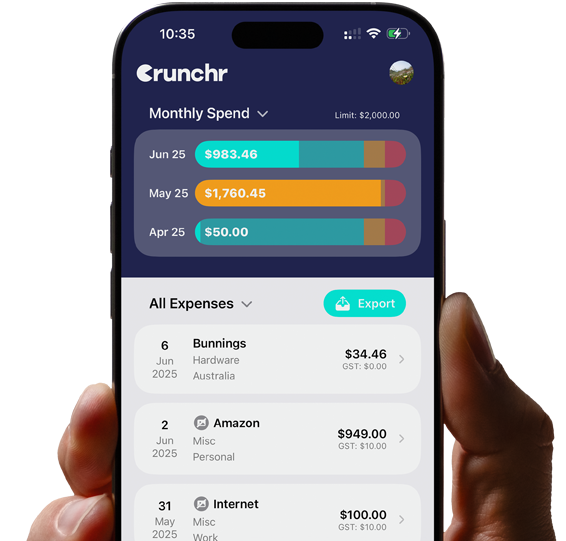
Crunchr helps businesses keep expenses and receipts more organized as they happen.
That is the real benefit.
Not making reimbursement feel bigger than it needs to be.
Making it easier.
Instead of relying on paper receipts and scattered emails and memory Crunchr gives businesses a clearer way to capture and manage expense information.
That means fewer missing receipts and fewer late claims and fewer awkward follow-ups.
It also means a better record of what has been spent.
It is not about perfection.
Most businesses do not need perfect.
They need a process that is easy enough for people to actually use.
A Better Experience for Employees
Employees notice when reimbursement is simple.
They also notice when it is not.
A clear process shows respect for their time and money.
If someone has paid for something on behalf of the business they should not have to fight to get reimbursed.
They should know what to do and where to submit it and whether the business has received it.
That kind of clarity matters.
It makes the whole process feel more professional.
And less awkward.
A Better Experience for the Business
The business benefits too.
Cleaner records.
Better visibility.
Less chasing.
Less manual admin.
Fewer missing receipts.
More confidence around what has been spent.
That does not mean reimbursement becomes exciting.
It probably never will.
But it can become easier.
And easier is valuable.
Especially when the alternative is another month of scattered receipts and last-minute follow-ups.
Final Thought
Expense reimbursement should not be complicated.
Someone spends money for work and the business needs the record and the right person reviews it and the employee gets paid back.
That should be the rhythm.
But without a clear process even simple reimbursements can become messy.
An expense reimbursement app helps by making it easier to capture receipts and submit claims and keep everything in one place.
Not because it makes every problem disappear.
It won’t.
But because it makes the process easier to see and easier to manage and easier to trust.
And for many US businesses that is the real win.
Not a perfect system.
Just one that finally feels under control.