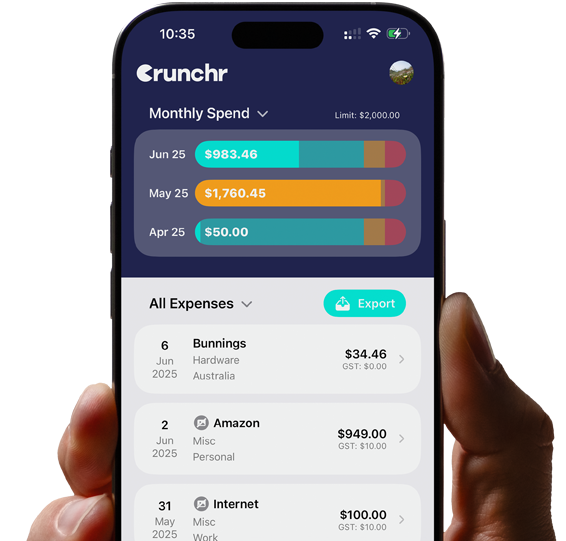
Expense Tracker App for Small Business: Because Receipts Shouldn’t Run Your Life
Small business owners do not need more admin.
They already have enough.
Customers. Invoices. Supplies. Payments. Emails. Repairs. Software. Staff. Contractors. Taxes. Someone asking a question at the exact moment you finally sit down to eat lunch.
Then there are receipts.
Gas receipts. Parking receipts. Home Depot receipts. Office supply receipts. Subscription invoices. Client meals. Shipping costs. Tools. Materials. Random purchases that made perfect sense at the time but look like a mystery six months later.
That is usually when the problem shows up.
Not when you buy the thing.
When you try to remember what it was for.
This is why a simple expense tracker app for small business can make such a big difference. Not because tracking expenses is exciting. It is not. But because losing receipts, guessing categories and rebuilding the year from bank statements is a terrible way to run a business.
Crunchr helps small business owners save receipts, organize expenses and keep cleaner records without turning the whole thing into another job.
The idea is simple.
Capture the receipt before it disappears.
Small business expenses get messy fast
One or two expenses are easy to remember.
A few hundred are not.
That is the part people underestimate. Small business spending does not usually happen in one neat place. It happens while you are doing everything else.
You buy materials on the way to a job. You grab printer paper between meetings. You pay for parking. You order a new charger because the old one died. You subscribe to software. You pay for postage. You stop for gas. You buy supplies at Home Depot or Lowe’s. You pay for lunch with a client and tell yourself you will remember who it was with.
At the time, you probably do.
Later, not always.
A bank statement might show the store and the amount. It does not always show what you bought, why you bought it, whether it was for a client, whether it belongs to a project, or whether it was partly personal.
That is where small business expense tracking becomes more than just “watching your spending”.
It becomes record keeping.
And record keeping is easier when it happens close to the purchase, not months later.
The receipt is the detail
A bank transaction tells you money moved.
A receipt tells you what happened.
That difference matters.
A $143 transaction at Staples could be office supplies, a printer cartridge, a chair mat, a charger, school supplies, or all of those in one purchase. A $92 transaction at Home Depot could be materials for a job, a repair for a rental property, or something for your own house. Amazon could be almost anything.
The transaction is a clue.
The receipt is the detail.
And sometimes the detail is the difference between a clean record and a guess.
Crunchr helps you keep that detail while it is still fresh. Take a photo. Add a note if you need to. Save it. Move on.
That is not complicated.
That is the point.
The real problem is “I’ll do it later”
Most expense tracking systems fail because they rely on later.
Later, I’ll enter it into a spreadsheet.
Later, I’ll upload the receipt.
Later, I’ll sort the folder.
Later, I’ll remember what that transaction was for.
Later sounds harmless.
Then tax season arrives, or your bookkeeper asks for receipts, or your CPA needs details, and suddenly later becomes a weekend of digging through email, bank statements, camera roll photos, gloveboxes and faded paper.
Small business owners do not need that.
They need a system that works while life is moving.
Crunchr is built around that small moment when the receipt is still in your hand. That is the easiest time to save it. That is when you still know what it was for. That is when a ten-second note can save a twenty-minute search later.
Paper receipts are not a business system
Paper receipts feel official.
They are still a mess.
They fade. They rip. They get lost. They sit in a hot truck until the ink almost disappears. They end up in a wallet, a drawer, a folder, a bag, the center console, or the one pile on your desk that you keep saying you will sort.
Some business owners are great with folders.
Most are not.
Not because they are disorganized people. Because they are busy people.
A folder only works if every receipt makes it into the folder, stays readable, and can be found when needed. That is a lot to ask from tiny pieces of thermal paper.
Crunchr gives receipts a better home.
A digital one.
And once a receipt is saved properly, it is no longer depending on your wallet, your memory, or that one drawer where everything goes to disappear.
What a small business expense tracker should actually do
A good expense tracker app for small business should not feel like accounting software pretending to be simple.
It should actually be simple.
Small business owners usually need a few practical things:
A quick way to save receipts.
A way to organize expenses.
A place to add notes.
A way to find receipts later.
A cleaner handoff for tax time, bookkeeping or reporting.
That is it for most people.
Not every business needs a giant finance dashboard. Not every owner wants to spend their evenings reviewing charts. Sometimes the biggest win is knowing where the receipt is.
Crunchr focuses on the practical side of expense tracking.
The part that usually breaks first.
Who Crunchr is useful for
Crunchr can help many types of small businesses, especially the ones where expenses happen on the run.
A contractor buying materials before heading to a job.
A consultant paying for travel, parking, software and client meetings.
A designer or creative buying subscriptions, equipment, fonts, printing or online tools.
A photographer buying gear, props, storage, editing software and travel.
A real estate professional tracking mileage-related costs, marketing, signage, subscriptions and meetings.
A tradesperson keeping receipts for tools, supplies, fuel, repairs and job materials.
A small retail owner dealing with packaging, shipping, supplies and maintenance.
A coach, trainer or service provider paying for bookings, equipment, courses, insurance, software and content tools.
Different businesses.
Same headache.
The receipt was there.
Then it wasn’t.
Spreadsheets are useful, but they are not enough
There is nothing wrong with a spreadsheet.
Spreadsheets are useful. Accountants use them. Bookkeepers use them. Business owners use them.
But spreadsheets usually come too late in the process.
You still have to collect the receipt. You still have to remember what the purchase was for. You still have to enter the details. You still have to attach or store the proof somewhere else. And you still have to keep doing that consistently.
That is where the system breaks.
Crunchr can sit before the spreadsheet.
Capture the receipt first. Review or export later.
That order makes more sense for a small business owner who is not sitting at a desk every time money is spent.
Because real expense tracking happens at gas stations, hardware stores, client meetings, job sites, airports, cafes and parking meters.
Not just in a spreadsheet.
The shoebox method is not a method
The shoebox method has one advantage.
It is easy at the start.
You throw the receipt in. Done.
Except you are not done. You have just postponed the work.
Eventually, someone has to open the box and deal with the pile. Match receipts to transactions. Guess categories. Work out what is business and what is personal. Read faded ink. Explain the weird ones. Find the missing ones. Apologize to the bookkeeper.
It is not a system.
It is a delayed problem.
Crunchr helps you deal with receipts before they become a pile.
Not perfectly.
Just earlier.
And earlier is usually much easier.
Your camera roll is not much better
Taking photos of receipts is better than keeping nothing.
But after a while, your camera roll becomes another shoebox.
Receipts mixed with family photos, screenshots, parking signs, random documents, pets, meals, videos, memes, and that photo you took of something at the store so you could “look at it later”.
You might have the receipt.
But finding it is another job.
A receipt photo only becomes useful when it is stored in a way you can actually search, sort and understand later.
Crunchr gives the receipt a proper place to live, instead of leaving it buried between everything else on your phone.
Expense tracking helps you understand the business
This part gets overlooked.
Keeping receipts is not only about tax season.
It also helps you see what the business is actually spending.
Small costs have a way of hiding. Subscriptions keep renewing. Supplies creep up. Tools and materials get bought in a rush. Shipping costs rise. Parking, gas and small purchases slowly become a bigger number than expected.
When expenses are scattered, it is hard to see patterns.
When they are captured and organized, you get a clearer picture.
You might notice costs you can cut. You might see which projects are more expensive to deliver. You might realize one category is growing faster than expected. You might simply feel less in the dark.
That matters.
A business feels easier to run when the money trail is clearer.
It makes tax season less painful
Tax season has a way of exposing every weak spot in your record keeping.
Receipts you meant to save.
Invoices you forgot to download.
Transactions that need explaining.
Subscriptions you cannot identify.
Purchases that were probably business-related, but now you are not completely sure.
Crunchr does not replace a CPA or tax professional. It does not decide what you can deduct. It does not give tax advice.
What it does is help you keep cleaner records so those conversations are easier.
Your CPA can help with what counts.
Crunchr helps you keep the proof.
That is a useful difference.
It also helps if you have a bookkeeper
Bookkeepers do not want mystery transactions.
They want details.
What was bought? What category does it belong to? Is there a receipt? Was it for a client? Was it for a project? Was part of it personal? Does it need a note?
If you can answer those questions when the purchase happens, things are easier.
If you wait six months, everything gets blurry.
Crunchr helps small business owners give bookkeepers better information without having to become bookkeeping experts themselves.
Less back and forth.
Less chasing.
Less “what was this for?”
Business and personal spending can get mixed up
This is very common, especially in small businesses.
You use the wrong card. You buy business and personal items in the same trip. You order something online and forget which account it went through. You pay for a business expense from a personal card because it was quicker.
It happens.
The problem is not that it happens. The problem is when there is no note, no receipt and no way to explain it later.
Crunchr helps capture the context.
If something is partly business and partly personal, add a note while you still remember. If something belongs to a client or project, record it then. If a purchase needs explanation, give future-you the explanation now.
Future-you will be grateful.
Real small business examples
You buy gas before driving to a job. Save the receipt.
You pick up materials from Home Depot. Save it before it fades in the truck.
You buy printer ink, paper and envelopes from Staples. Record it.
You pay for parking at a client meeting. Add the client name.
You order software online. Save the invoice.
You buy tools for a job. Keep the receipt with the expense.
You pay for shipping. Save the record.
You buy something that is partly business and partly personal. Add a note.
You pay for a course or training. Keep the receipt.
None of this is exciting.
That is fine.
It is not meant to be exciting. It is meant to stop the business from turning into a messy paper chase later.
The best system is the one you will actually use
This sounds obvious, but it matters.
The best expense tracker app for small business is not the one with the longest feature list.
It is the one you actually open when you have a receipt.
If the process takes too long, you will stop doing it. If it feels like accounting homework, you will avoid it. If it requires too many steps, the receipt will end up in the car again.
Simple wins because simple gets used.
Crunchr keeps the focus on the habit that matters most.
Get the receipt.
Save it.
Add context if needed.
Move on.
Do not wait until the end of the month
Monthly admin sounds responsible.
And it can be.
But receipts are easiest to deal with when they are fresh. The longer you wait, the more your memory has to do.
At the end of the month, that $48 transaction might look familiar but not clear. At the end of the quarter, it is even worse. At the end of the year, good luck.
The best time to save a receipt is when you get it.
Not later.
Now.
That is the small shift Crunchr helps with.
Start with the next receipt
Do not start by trying to fix the whole past year.
That is how people get overwhelmed.
Start with the next receipt.
The next time you buy something for the business, save it properly. Add a note if it needs one. Then do it again.
One receipt is easy.
That is the point.
A good expense habit is built one small action at a time.
The bottom line
If you need an expense tracker app for small business, Crunchr gives you a simple way to save receipts, organize expenses and keep better records without making the process feel bigger than it needs to be.
It helps with the everyday stuff that usually causes the problem.
Lost receipts.
Mystery transactions.
Messy spreadsheets.
Shoeboxes full of paper.
Last-minute tax season panic.
For small business owners, freelancers, contractors and service providers, that can make a real difference.
Not because expense tracking is exciting.
It is not.
But running a business is hard enough without chasing receipts.
Crunchr helps make that part easier.