Why It Becomes a Problem Faster Than You Think
Employee expenses should be easy.
Someone pays for something work-related.
They save the receipt.
The company reimburses them.
That should be the whole story.
But most businesses know it rarely works that smoothly.
Receipts get left in cars. They end up in wallets, kitchen drawers, laptop bags, inboxes and phone camera rolls. Some are saved properly. Some are half saved. Some are impossible to find when someone finally needs them.
Usually, nobody is being careless on purpose.
People are just busy.
Work keeps moving, customers still need attention, meetings keep happening, and a small receipt from three weeks ago does not always feel urgent in the moment.
That is where employee expense management starts to become more important than people expect.
Not because one missing receipt ruins everything.
It doesn’t.
But because small gaps turn into bigger gaps when they happen over and over again.
A delayed claim here. A missing receipt there. A manager who has not approved something yet. A finance person trying to match a card transaction to a vague email that says “lunch receipt attached”.
It starts small.
Then it becomes part of the way the business runs.
And that is when it becomes a problem.
Spending Is Not the Real Issue
Every business spends money.
That is normal.
Employees travel for work. They meet clients. They buy supplies. They pay for parking. They use software. They attend conferences. They order small things the business needs because it makes sense at the time.
The spending is not always the concern.
The concern is what happens after the money has already gone out.
Was the expense recorded properly? Was the receipt kept? Was it approved by the right person? Was it for the right job, department or client? Did it match the company policy or did it just slide through because everyone was too busy?
And later, when the business needs accurate records for reporting or tax preparation, can anyone find the details quickly?
That is where things often get messy.
Because paying for something takes seconds.
Keeping a clear record of it takes a system.
What Employee Expense Management Means
Employee expense management is the process a business uses to track, approve, record and reimburse work-related expenses paid by employees.
That might include mileage, meals, hotels, flights, parking, tolls, office supplies, subscriptions, training, phone costs, internet costs or home office items.
It might be happening in a small company with only a few people.
Or it might be happening across multiple teams in different states.
The size of the business changes the volume, but the basic problem is the same.
Money is being spent on behalf of the company, so the company needs a clear way to see it, approve it and keep the right documentation.
Not to create more paperwork.
To avoid confusion later.
Most Businesses Start With a Simple System
A messy expense process usually does not happen overnight.
It grows quietly.
At first, a spreadsheet works fine. A folder of receipts is fine. A few emails between employees and the owner are fine.
Everyone knows what is going on.
Someone remembers why the purchase was made. Someone knows where the receipt is. Someone knows which expenses are still waiting to be reimbursed.
Then the business gets busier.
More employees start making purchases. More receipts come in. More claims need approval. More transactions need to be matched.
The simple system keeps going because it still works well enough.
At least on the surface.
That is where many businesses get stuck.
A process can feel manageable for a long time while still wasting hours every month.
The Small Expenses Are Often the Hardest
Large purchases usually get attention.
People notice them.
They are approved properly. They are discussed. They are easier to remember.
Small expenses are different.
A $15 parking receipt. A $28 lunch. A $42 office supply purchase. A $12 monthly tool.
Each one feels minor.
But employee expenses are rarely isolated.
They happen again and again across different employees, clients, projects and departments.
Over time, the small things create a surprisingly large amount of admin.
It is the chasing. The checking. The approving. The correcting. The “can you resend that?” message. The “do you still have the receipt?” question.
That is the part that drains time.
Not the expense itself.
The mess around it.
Why Receipts Still Create So Much Trouble
Receipts are small, but they cause plenty of problems.
They fade. They tear. They get misplaced. They sit in glove compartments until the ink is barely readable. They arrive as screenshots, PDFs, photos, email attachments and forwarded messages.
Sometimes one employee sends everything clearly.
Another sends a blurry photo.
Someone else waits until the end of the month and sends ten things at once.
None of this is unusual.
It is just how businesses work when there is no simple process in place.
The trouble starts when the business needs to find something later.
Maybe it is for bookkeeping.
Maybe it is for an IRS record.
Maybe it is for a client recharge.
Maybe it is for an internal spending review.
If the proof is scattered, the work becomes harder than it needs to be.
Late Claims Create a False Picture
Late expense claims are easy to understand.
People forget.
They are not trying to make life difficult. They are just focused on their work.
But late claims can make the numbers look wrong.
A business might think the month is finished, then a group of old expenses comes through and changes the picture.
A budget that looked fine becomes tighter. A project that looked profitable looks different. Cash flow feels less predictable than it should.
The longer someone waits, the harder it is to remember the context as well.
What was the purchase for? Was it approved? Was it for this client or another one? Was it personal or business-related? Was the full amount claimable?
These questions are small.
But they slow people down.
The Hidden Cost Is Usually Time
Most businesses look at employee expenses by amount.
That makes sense.
A reimbursement is a dollar figure.
But the cost of managing that reimbursement is often ignored.
A simple expense can involve the employee, the manager, the bookkeeper, the accountant and the business owner in some small way.
One person submits it. Another person approves it. Someone else records it. Someone checks the receipt. Someone matches it to the transaction. Someone may need to ask a question.
For one small purchase, that is a lot of movement.
And if this is happening every week, the time adds up quickly.
That is why better employee expense management is not just about controlling spending.
It is about removing unnecessary work.
Clarity Changes the Whole Process
There is a different feeling when expenses are easy to see.
You are not chasing people.
You are not searching old inboxes.
You are not trying to remember what happened two months ago.
The information is there when the business needs it.
That makes a real difference.
It helps with budgeting, reporting, reimbursements, tax preparation, cash flow and general decision-making.
It also reduces that low-level pressure that comes from knowing the records are not quite as clean as they should be.
Most business owners know that feeling.
Nothing is technically wrong.
But something feels a little unfinished.
A clearer expense process removes a lot of that.
Month-End Should Not Feel Like Cleanup
Month-end should be a review.
For many businesses, it becomes cleanup.
Employees are asked to send missing receipts. Managers are asked to approve claims quickly. Finance is trying to close things off. Someone realizes a few expenses are missing. Someone else says they will send them tomorrow.
Then tomorrow becomes next week.
It is not a crisis.
It is just frustrating.
And when it happens every month, it becomes part of the business culture.
That is usually a sign the process needs to be easier.
Not more complicated.
Easier.
Because people are far more likely to follow a system that fits naturally into the way they already work.
Employees Do Not Want More Forms
Most employees are not excited about expense reporting.
They want to do their job, get reimbursed and move on.
If the process feels slow, they delay it. If it feels confusing, they make mistakes. If it depends on remembering details later, things get missed.
That is not unusual.
That is human.
A good expense process should be simple enough that people can use it without thinking too much about it.
Buy something for work. Capture the receipt. Submit the details. Move on.
That is what most businesses actually need.
Not a complicated system that looks good on paper but gets ignored in real life.
Digital Records Make Life Easier
Paper receipts still exist.
They probably will for a while.
But relying on paper alone is not a great plan.
Digital records are easier to store, search, share and review. They are also much easier to keep consistent across a team.
When an employee captures a receipt at the time of purchase, the business is not depending on that piece of paper surviving for months.
That alone helps.
A receipt stored in one place is better than a receipt sitting in someone’s car.
A clear digital record is better than an email chain nobody wants to search through later.
Small improvements like that can change the whole experience.
Better Records Help at Tax Time
Tax season is when messy expenses become obvious.
The problem is that tax preparation is not really built during tax season.
It is built all year.
Every receipt that gets captured properly helps later. Every expense that is recorded clearly helps later. Every claim that is handled close to the moment it happens helps later.
By the time a business is preparing records, the easiest work has already been done or missed.
That is why employee expense management matters beyond day-to-day admin.
It gives the business cleaner information when that information actually matters.
And while software does not replace a CPA or tax professional, it can make the records easier to work with.
That is a big difference.
Expense Data Can Tell You More Than You Expect
Employee expenses are not just admin.
They can show patterns.
You might see one department spending more than expected. You might notice travel costs creeping up. You might find subscriptions nobody uses. You might discover that small monthly purchases are adding up quietly in the background.
These things are easy to miss when expenses are scattered.
They become much easier to see when everything is in one place.
That is where expense management becomes more useful.
It is not only about recording what happened.
It helps the business understand what is happening.
Small Businesses Feel the Pressure More
Large companies usually have finance teams.
Small businesses often do not.
Or they have one person doing bookkeeping, admin, payroll, customer service and a bit of everything else.
That is why messy expenses can be so draining for small businesses.
There is less time to waste.
A business owner should not have to spend an evening sorting receipts. A bookkeeper should not have to chase the same employee multiple times. An employee should not have to wait too long to be paid back for something they bought for work.
The process should feel lighter than that.
Especially when the business is already busy.
Remote and Hybrid Work Have Changed the Picture
Work is not always tied to one office anymore.
That changes how expenses happen.
Employees might buy things from home. They might use their own internet. They might travel between locations. They might pay for coworking space, tools, software or small items they need to keep working.
Some of these expenses are straightforward.
Others need a little more clarity.
That is why a simple process matters even more now.
When people are working from different places, the business still needs one clear way to capture and review spending.
Otherwise, the records become scattered very quickly.
Clear Policies Still Matter
Expense software helps, but the rules still need to make sense.
Employees should know what they can claim, what needs approval first, how quickly receipts need to be submitted and who is responsible for approving different types of spending.
If the policy is too long, too vague or too hard to follow, people will guess.
Sometimes they will ask questions.
Sometimes they will just do what seems reasonable.
That can create problems later.
A good policy does not need to be complicated.
Clear rules. Clear limits. Clear expectations.
That is usually enough.
“I’ll Do It Later” Is the Problem
Later feels harmless.
Until later turns into a pile of old receipts.
By then, the details are harder to remember. The receipt might be missing. The manager might not remember approving the purchase. The transaction might be harder to match.
This is why expenses are easier to manage when they are handled close to the time they happen.
Not weeks later.
Not at the end of the quarter.
Not when everyone is already trying to prepare records.
The longer the delay, the more effort it takes to clean up.
Most people know this.
They just need a system that makes it easier to act sooner.
Where Crunchr Fits In
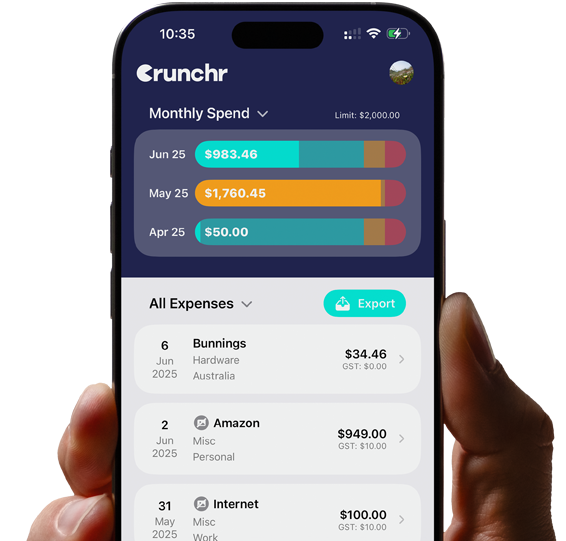
Crunchr helps make expense tracking easier by giving businesses a clearer way to capture and organize receipts as they happen.
It is not about making employee expense management feel bigger than it needs to be.
It is about making the everyday part simpler.
Instead of relying on memory, old emails, paper receipts or last-minute catch-ups, Crunchr helps keep expense records in one place.
That gives the business a clearer view of what has been spent and makes it easier to stay on top of records throughout the year.
Not perfect.
Just clearer.
And for many businesses, that is exactly what is missing.
The Real Benefit Is Confidence
The biggest benefit of employee expense management is not always the admin saving.
That matters, of course.
But confidence matters too.
Confidence that receipts are stored. Confidence that reimbursements are fair. Confidence that expenses can be reviewed. Confidence that tax time will not become a scramble.
Messy records create background stress.
Even when nothing is seriously wrong, the business can still feel unclear.
Clear records feel different.
They make decisions easier.
They make conversations easier.
They make the whole process feel more under control.
A Simpler Way to Think About It
Employee expense management does not have to feel like corporate red tape.
At its best, it is just a simple rhythm.
Money goes out.
The receipt is captured.
The expense is reviewed.
The record is kept.
The business can see what happened.
That is all most companies are trying to achieve.
Simple only works when people can actually follow it.
So the easier the process becomes, the better the result usually is.
Final Thought
Employee expenses are not going away.
People will keep buying things for work. Receipts will keep being created. Claims will keep needing approval. Records will still matter when tax season comes around.
The question is whether the process stays scattered or becomes easier to manage.
Because a business does not need more admin.
It needs more clarity. Fewer missing receipts and fewer late claims and fewer awkward follow-ups and fewer month-end surprises.
Employee expense management helps with that.
Not because it makes everything perfect.
It won’t.
But because it makes expenses easier to see and easier to track and easier to trust.
And that can make a real difference.
Not a perfect system.
Just one that finally feels under control.